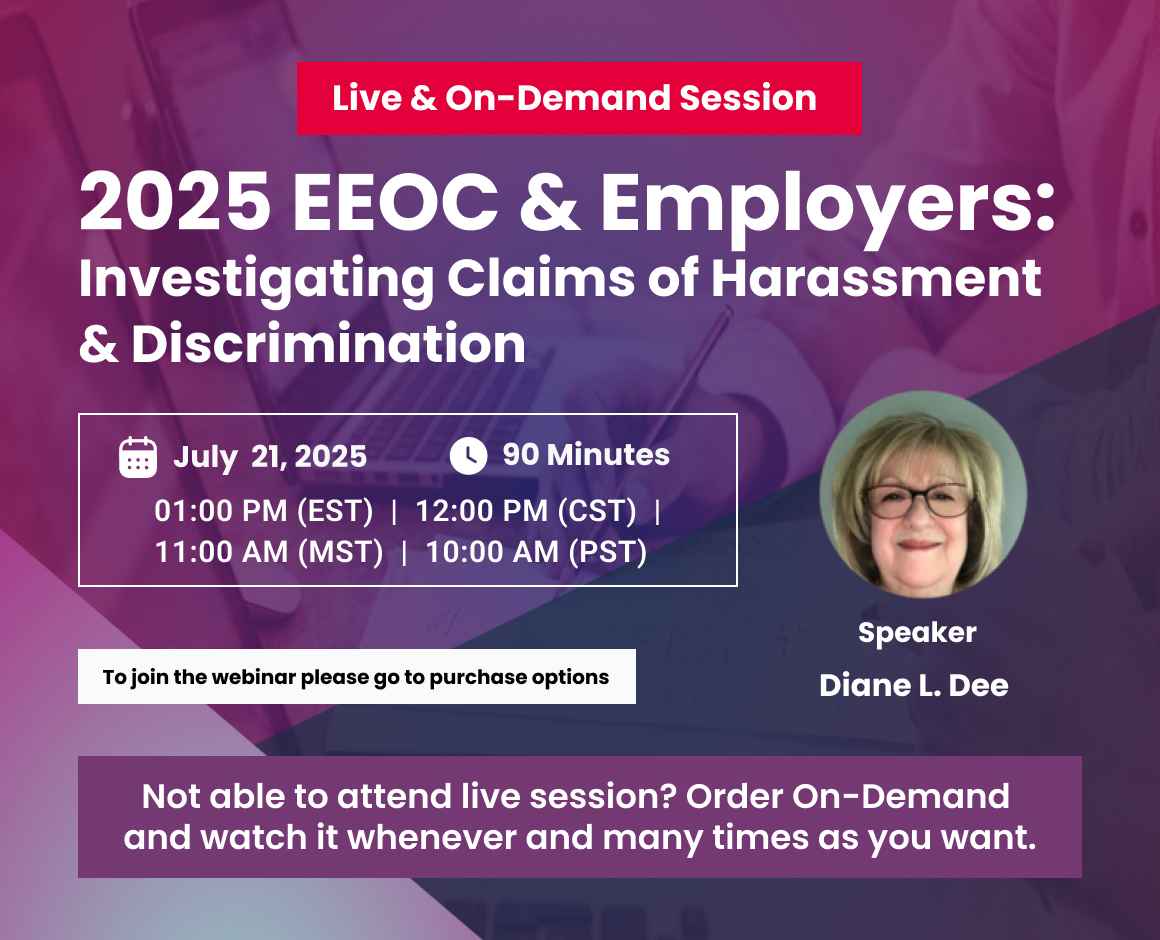
Investigating EEOC Complaints of Harassment & Discrimination Charges and Responding to Those Charges in 2022
"Not able to attend the live webinar? Purchase the recorded session and watch it at your convenience"
"The recording is added to your account within 24 hours of the live session, and we will email you when it is ready."
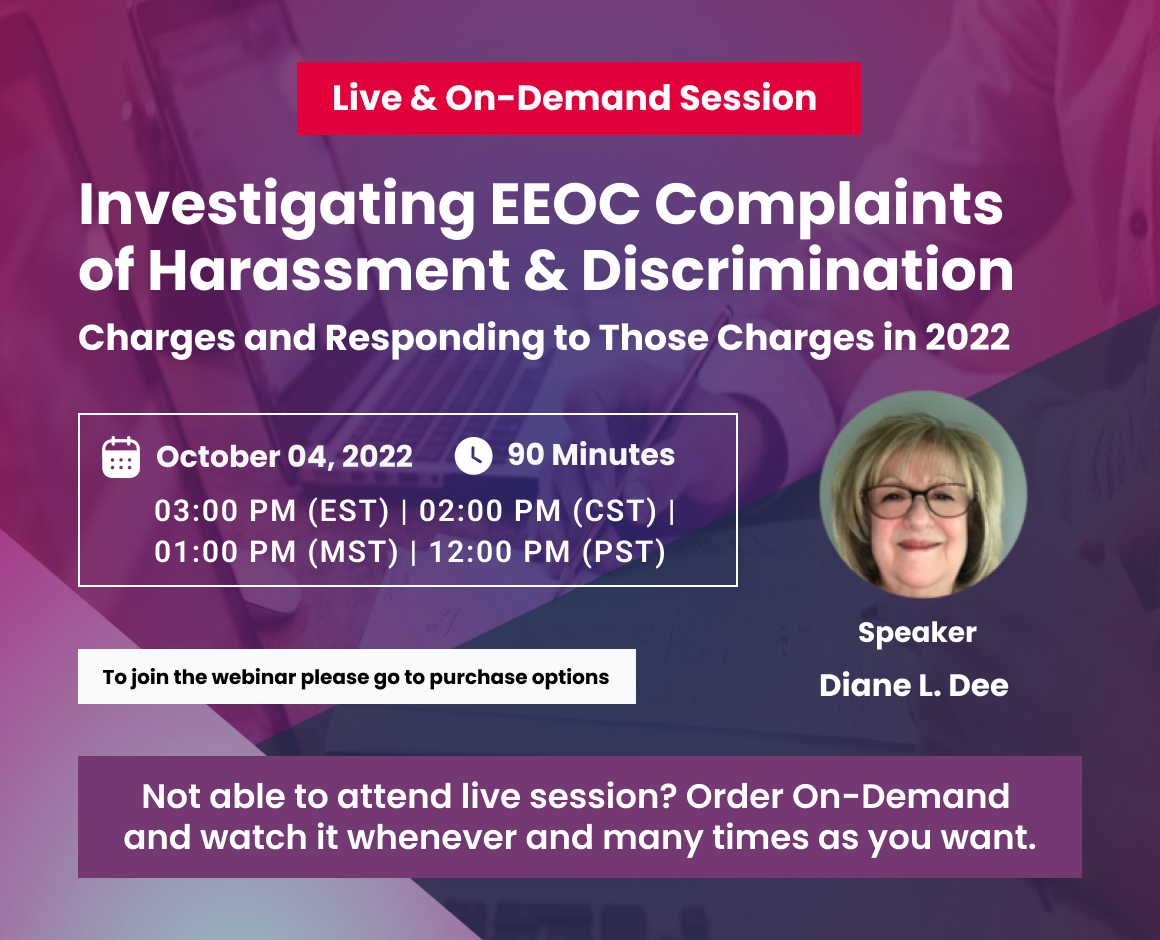
Webinar Overview
EEOC on Inequity, Harassment, and Discrimination in 2022
With employment discrimination on the rise, EEOC encourages employers to provide anti-harassment training to their employees and managers and to swiftly investigate and resolve employees’ complaints of workplace harassment and discrimination.
Employees should bring any harassment they face into the management’s attention. If an employee lodges a complaint against a colleague or the employer itself, an investigation is a required step since courts have ruled that failure to investigate on the part of an employer is akin to discrimination.
Employers should confront the harasser to immediately stop the unwelcomed conduct. They should establish an effective complaint and investigation process against harassment that encourages employees to raise valid concerns before they escalate.
What’s the process for employees to follow when filing a charge of discrimination with the EEOC and State/Local Agencies? What can employers expect after a charge is filed? What does an unbiased investigation look like? How’s an investigator selected?
How do the EEOC complaints hurt employers? What happens when EEOC penalties are levied against employers? What should employers NEVER do when a complaint has been received or an active investigation is going on?
How can you mitigate the risk of legal ramifications when conducting investigations? What are the stages of investigation and what consequences does non-compliance bring?
Join us on Edui to find out!
EEOC and Employers: Harassment Complaints to Lawsuits
- What are the responsibilities and functions of the EEOC?
- What is the Federal legislation requiring equal treatment of employees?
- Title VII of the Civil Rights Act of 1964: Original protected classes and currently-acknowledged protected classes; further amended in 2020
- Best practices to avoid an EEOC investigation
- Best practices for avoiding claims of sexual harassment
- What’s disparate treatment v. disparate impact?
- Different forms of Harassment and applicable court cases
- What’s Quid-Pro-Quo harassment and Hostile Work Environment?
- What are the charges of retaliation and discrimination?
- What’s the process of filing a charge with the EEOC?
- Common reasons employees state for not filing a claim
- EEOC determinations
- Conciliation process
- How to establish Affirmative Action programs?
- EEOC’s authority and role when adjudicating claims of harassment and discrimination
- Seriousness of EEOC complaints and costs of litigation
Harassment Claims, Investigations, and Consequences
- Formal complaints and the investigative process
- How to create a plan for your investigation?
- How to ensure confidentiality?
- Providing interim protection for the alleged victim
- Utilizing internal and external investigators
- How to develop interview questions and conduct interviews?
- Making a determination
- Closure of the investigation
- How to develop a written summary of investigation results?
Why is it Important to Attend?
Organizations and employers have legal and moral responsibilities to support diversity in their workplaces and to ensure compliance with all equal employment opportunity rules and regulations. Unfortunately, workplaces have not always been welcoming to women and minorities, and many people have faced prejudicial behavior when seeking employment or while on the job.
While laws like the Civil Rights Act of 1964 have improved the working lives of many, there are still serious issues that require attention and action. Human Resource professionals are especially important for creating hospitable and inclusive work environments.
Policies that discriminate against protected classes of individuals, either explicitly or accidentally, are illegal. Thus, even unintentionally discriminatory practices that disparately impact those that are vulnerable to prejudicial treatment must be prevented. Investigating an employee’s claim of discrimination or harassment requires immediate action on the part of employers to satisfy the recommendations of the Equal Employment Opportunity Commission (EEOC).
Responsiveness to a complaint and an investigation will not only yield the best information and evidence, but it will also enhance both the investigator’s and employer’s credibility. Investigations can help the organization identify and resolve internal problems before they become widespread.
Given that every complaint has the potential to become a lawsuit, employers should investigate every case in a manner in which it can be presented to a court of law, if necessary. As potentially disruptive as investigations can be, they must be prompt, thorough, and effective to ensure all parties’ protection.
Meet Your Instructor

Diane L. Dee
SPHR, SHRM-SCP | Founder, Advantage HR Consulting
Diane L. Dee, President of Advantage HR Consulting, LLC, has over 25 years of experience in the Human Resources arena. Diane’s background includes experience in Human Resources consulting and administration in corporate, government, consulting, and pro bono environments. Diane founded Advantage HR Consulting, LLC, in early 2016. Under Diane’s leadership, Advantage HR provides comprehensive, cost-effective Human Resources solutions for small to mid-sized firms in the greater Chicagoland area. Additionally, Diane conducts webinars on various HR topics for various compliance training firms across the country.
Diane holds a Master Certificate in Human Resources from Cornell University’s School of Industrial and Labor Relations and has attained SPHR, SHRM-SCP, sHRBP, and HRPM® certification.
Diane is a member of the National Association of Women Business Owners and the Society for Human Resource Management. Additionally, Diane performs pro bono work through the Taproot Foundation, assisting non-profit clients by integrating their Human Resources goals with their corporate strategies.
Frequently Asked Questions
Sign up now on pedu.online to discover a wide range of webinars from industry specialists. Choose your preferred access type (‘Live Only’, ‘Live + Recorded Session’, or ‘Recorded Session Only’), and simply click on ‘Buy Now’ to get enrolled.
Yes. Eligible sessions are approved for SHRM PDCs and HRCI recertification credits. After you attend live (or finish the Recorded Session), we automatically email your certificate with the activity ID you can enter directly into your SHRM or HRCI portal.
After checkout, you will receive an instant confirmation along with a calendar invite. The actual join link will be emailed to your registered email address 24 hours before, and again 1 hour before the webinar begins.
Don’t worry! If you choose the “Live + Recorded Session” or “Recorded Session only” access option during checkout, the recording will land in your inbox automatically after the session concludes. It is saved in our cloud storage so you can watch it as many times as you want, anytime, from anywhere.
Yes. You can explore your industry with your colleagues. The 5–10 and 11+ team options cover a group on a single purchase, and everyone who attends can receive their own certificate.
Live-only access doesn’t include the replay. However, “Live + Recorded Session” and “Recorded Session only” do include unlimited cloud viewing. You can also add a downloadable MP4 video to keep forever at checkout. We offer soft-copy transcripts (comprehensive word-for-word documents) that can be bundled with your order so you never miss a detail.
Yes! At the end of each live webinar, we host a real-time Q&A session where you have the opportunity to interact with our industry experts and get answers to your specific queries.
Receive a 100% refund on any upcoming webinar if you cancel at least 48 hours before the scheduled start time.
Pack Of 5 Webinars
$599
/ 12 months- Attend any 5 live, recorded Session, or a mix of both
- 12-Month validity.
- Live webinar access
- Recorded Session
- SHRM & HRCI credit on every session
- Single-user license
Annual Unlimited Access Pass
MOST POPULAR$999
/ 12 months- Attend unlimited live, recorded Session, or a mix of both
- 12-Month validity.
- Live webinar access
- Recorded Session
- SHRM & HRCI credit on every session
- Single-user license
Pack Of 10 Webinars
$799
/ 12 months- Attend any 10 live, recorded Session, or a mix of both
- 12-Month validity.
- Live webinar access
- Recorded Session
- SHRM & HRCI credit on every session
- Single-user license
Upcoming Webinars
Explore live and Recorded Session sessions presented by top industry experts.

Form I-9 & E-Verify Compliance : Prevent Costly Errors and Pass ICE Inspections
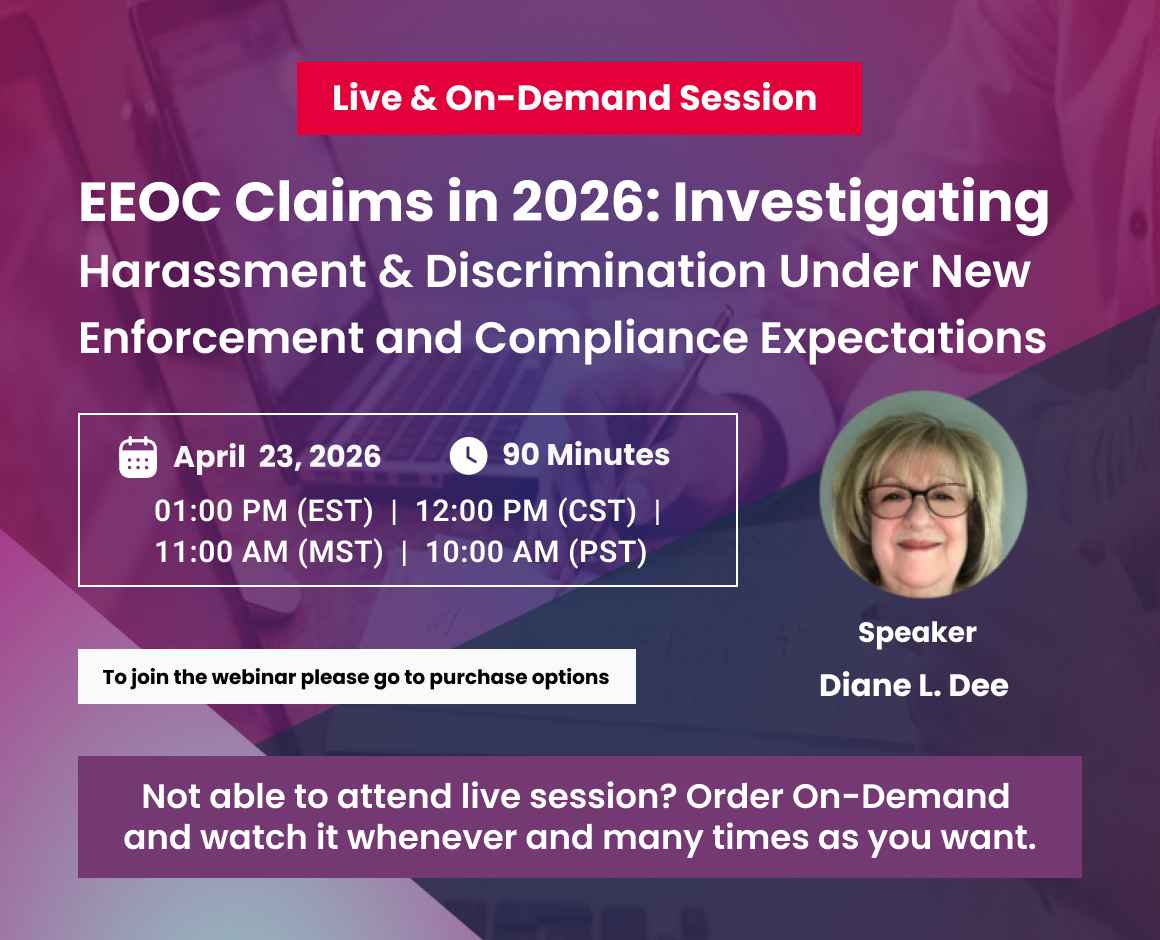
EEOC Claims in 2026: Investigating Harassment & Discrimination Under New Enforcement and Compliance Expectations