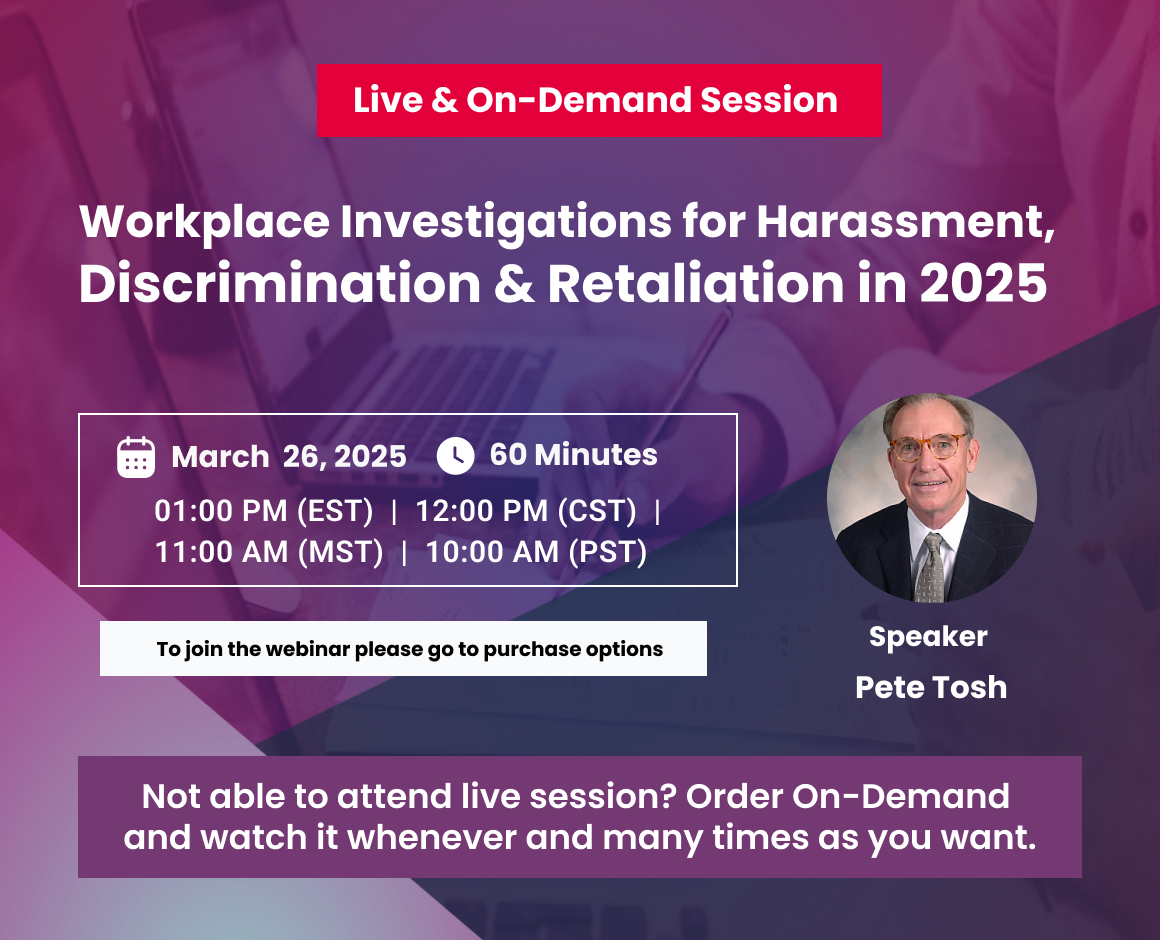
Workplace Investigations for Harassment, Discrimination & Retaliation in 2025
"Not able to attend the live webinar? Purchase the recorded session and watch it at your convenience"
"The recording is added to your account within 24 hours of the live session, and we will email you when it is ready."
Webinar Overview
How to Conduct Workplace Investigations in 2025
Internal investigations are fact-findings initiatives conducted to uncover the truth about alleged misconduct. And this must be done without compromising the relationship with employees or unnecessarily damaging anyone’s reputation. All of which require planning, consistent execution, analytical skill, and an understanding of the legalities involved.
Employers are legally mandated to investigate harassment, discrimination, retaliation, safety, and certain other types of complaints. And good investigators first create a plan that includes:
• What is the objective?
• Who will be interviewed?
• What will be investigated?
• What evidence needs to be collected?
Workplace investigations are crucial when it comes to establishing a safe and welcoming work environment. However, these investigations are often complex and can involve navigating sensitive topics and disputes.
A poorly conducted internal investigation can cost a company financially and damage its reputation, not to mention the reputation of the person tasked with overseeing such a probe. Some of the common mistakes made include:
• Failing to plan
• Delaying an investigation
• Not remaining objective
• Using aggressive interviewing tactics
• Not conducting a thorough investigation
• Failing to reach a conclusion with a written report
Conducting workplace investigations is one of the most challenging duties that HR professionals and other managers must face due to today’s workforce demographics, new employment laws, employees being more aware of their rights – a quagmire of potential landmines - and many managers not trained to do so.
Employers must demonstrate fairness when conducting workplace investigations. and investigations should be thorough and well-documented before an employer takes any action. Additionally, effective workplace investigations need to be guided by the following principles:
• Neutrality—HR and other personnel involved in an investigation must be detached from an incident, remain objective, have no personal stake in the outcome, and give all employees involved the opportunity to provide their version of the incidents.
• Thoroughness—To ensure that the proper decision is made investigators must be thorough in uncovering all the necessary information while asking detailed questions during interviews
• Timeliness—Once an investigation is triggered, investigators must act promptly to avoid further acts of wrongdoing with any disciplinary action administered in a timely manner to avoid legal issues.
What You Will Learn:
• Recognizing the Situations Where an Internal Investigation May be Warranted
• Our Role When Conducting Investigations
• Information to Obtain to Determine the Best Approach to the Investigation
• Determining Who Should be Interviewed
• Utilizing an Introductory Interview Guide
• Following a Proven Interview Methodology
• Utilizing an Investigatory Interview Questionnaire
• Closing the Interviews
• Preparing an Investigatory Findings Report
Why You Should Attend
An internal investigation is a formal inquiry to determine whether workplace policies or regulatory practices have been violated. Investigations can follow a:
• a complaint
• allegation
• suspicion of misconduct
• fraud
• harassment accusations
• or many other reasons covered by federal, state, and/or local employment laws.
The goal of any internal investigation is to obtain a straightforward view of the facts:
• what happened
• when it happened
• who was responsible
• who may have been harmed
• what actions may be necessary to prevent the alleged wrongdoing from reoccurring
Internal investigations assist organizations in gathering information, fashioning defenses, and crafting remedies. Specifically, internal investigations are useful for organizations to identify where there are needs for remediation.
The final investigative report should include:
• The incident investigated, with dates
• The individuals involved
• Key factual findings
• Applicable employer policies
• Interviewees’ statements
• Conclusions
• Issues that could not be resolved
• Employer’s follow-up action
It is critical to investigate an allegation quickly. Stretching an investigation out over a lengthy period tells employees the alleged misconduct is not important. And as time goes by, it becomes more difficult to collect evidence and get witnesses to talk, details are forgotten, and documents disappear.
And if the organization terminates or disciplines an employee and that person files a lawsuit or complaint the investigation report will be critical in protecting the company in court. While every complaint is unique, having a well-defined, consistent process in place can ward off future lawsuits.
Who will Benefit
- HR Managers
- Any line managers
- HR Professionals
- Supervisors
- Company Leadership
Ask your question directly from our expert during the Q&A session following the live event.
Meet Your Instructor

Pete Tosh
Founder, The Focus Group | HR & Leadership Expert
Pete Tosh is the Founder of The Focus Group, a management consulting and training firm that assists organizations in sustaining profitable growth through four core disciplines:
· Implementing Strategic HR Initiatives
· Maximizing Leadership Effectiveness
· Strategic Planning
· Enhancing Customer Loyalty
The Focus Group has provided these consulting and training services to manufacturing and service organizations across the U.S., Canada, Europe, and the Middle East. Pete has worked closely with the leadership teams of organizations such as Exxon, Brinks, EMC, State Farm, Marriott, N.C.I. YKK and Freddie Mac
Prior to founding his own firm 25 years ago, Pete had 15 years of experience — at the divisional and corporate levels — in Human Resource and Quality functions. Pete held leadership positions — to include the V.P. of Human Resources and Quality — with Allied Signal, Imperial Chemical Industries, Reynolds Metals, Charter Medical, and Access Integrated Networks.
Pete holds a B.A. degree in Psychology from Emory and Henry College and a Master’s degree in both Business Administration and Industrial Psychology from Virginia Commonwealth University. Pete is also co-author of Leading Your Organization to the Next Level: the Core Disciplines of Sustained Profitable Growth.
Frequently Asked Questions
Sign up now on pedu.online to discover a wide range of webinars from industry specialists. Choose your preferred access type (‘Live Only’, ‘Live + Recorded Session’, or ‘Recorded Session Only’), and simply click on ‘Buy Now’ to get enrolled.
Yes. Eligible sessions are approved for SHRM PDCs and HRCI recertification credits. After you attend live (or finish the Recorded Session), we automatically email your certificate with the activity ID you can enter directly into your SHRM or HRCI portal.
After checkout, you will receive an instant confirmation along with a calendar invite. The actual join link will be emailed to your registered email address 24 hours before, and again 1 hour before the webinar begins.
Don’t worry! If you choose the “Live + Recorded Session” or “Recorded Session only” access option during checkout, the recording will land in your inbox automatically after the session concludes. It is saved in our cloud storage so you can watch it as many times as you want, anytime, from anywhere.
Yes. You can explore your industry with your colleagues. The 5–10 and 11+ team options cover a group on a single purchase, and everyone who attends can receive their own certificate.
Live-only access doesn’t include the replay. However, “Live + Recorded Session” and “Recorded Session only” do include unlimited cloud viewing. You can also add a downloadable MP4 video to keep forever at checkout. We offer soft-copy transcripts (comprehensive word-for-word documents) that can be bundled with your order so you never miss a detail.
Yes! At the end of each live webinar, we host a real-time Q&A session where you have the opportunity to interact with our industry experts and get answers to your specific queries.
Receive a 100% refund on any upcoming webinar if you cancel at least 48 hours before the scheduled start time.
Pack Of 5 Webinars
$599
/ 12 months- Attend any 5 live, recorded Session, or a mix of both
- 12-Month validity.
- Live webinar access
- Recorded Session
- SHRM & HRCI credit on every session
- Single-user license
Annual Unlimited Access Pass
MOST POPULAR$999
/ 12 months- Attend unlimited live, recorded Session, or a mix of both
- 12-Month validity.
- Live webinar access
- Recorded Session
- SHRM & HRCI credit on every session
- Single-user license
Pack Of 10 Webinars
$799
/ 12 months- Attend any 10 live, recorded Session, or a mix of both
- 12-Month validity.
- Live webinar access
- Recorded Session
- SHRM & HRCI credit on every session
- Single-user license
Upcoming Webinars
Explore live and Recorded Session sessions presented by top industry experts.

Managing Toxic & Other Employees Who Have Attitude Issues
Workplace Investigations for Harassment, Discrimination & Retaliation in 2025